 Oahu Dolphin Tour
Swim With Dolphins on Oahu: What's Actually Legal
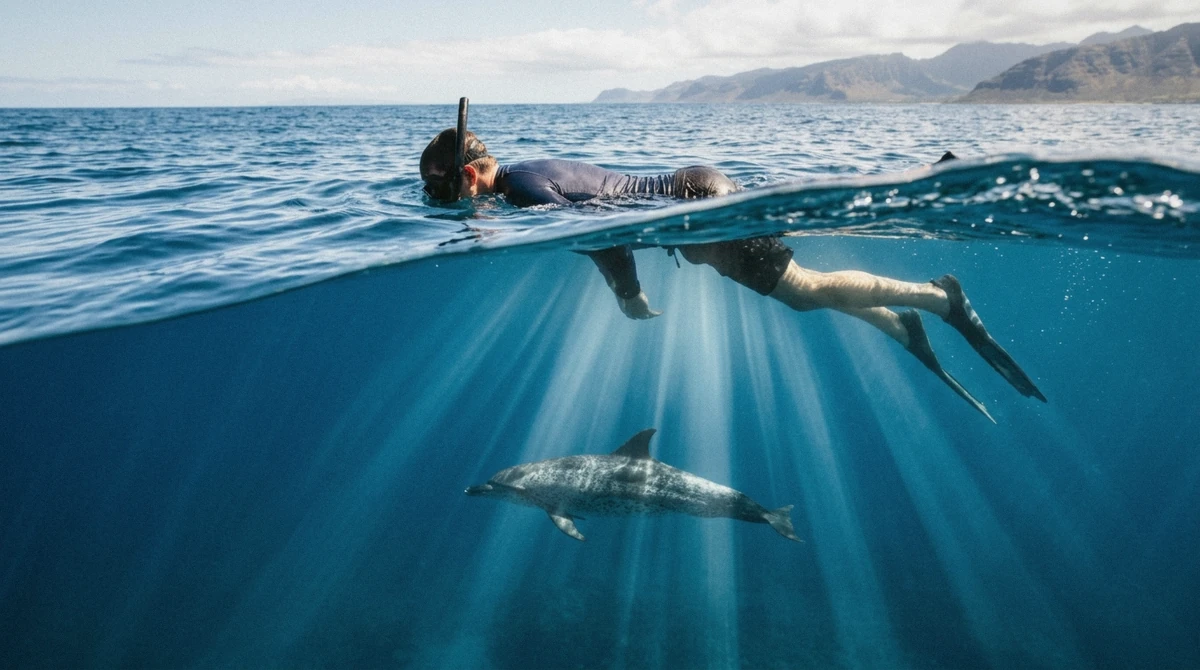
Yes, you can swim with dolphins Oahu boats reach on the west coast, but not with every species and not the way older blog posts describe. Since October 2021, federal rules keep every boat and swimmer 50 yards from Hawaiian spinner dolphins, which rules out the animal most people picture when they search for this. The swims that still happen target three other species, run from a slowly moving boat, and last seconds to a minute at a time. Below is the actual rule, which dolphins you go in with, how the swim itself works, and who it suits.
Quick answer
You can swim with dolphins on Oahu, but only with spotted, bottlenose or rough-toothed dolphins from a moving boat off the Waianae coast; spinner dolphins are watch-only within 50 yards under federal law. Two boats run dedicated swims, at $193.88 and $187.43, and entries last seconds to a minute across up to four tries. See how these fit among Oahu dolphin tours compared by price and format.
Key takeaways
- Spinner dolphins are legally off-limits for swimming since 28 October 2021; you may not approach one within 50 yards from a boat, kayak, or by swimming out from shore
- Legal swim species are spotted, bottlenose and rough-toothed dolphins, found further offshore than resting spinner pods
- Dolphin Excursions is the only tour in this comparison that guarantees a sighting in writing, at $193.88
- The Indigo Ocean catamaran swim allows up to four in-water entries across its 4-hour trip for $187.43
- Non-swimmers and toddlers aren't shut out; watch-deck tours cover the same coastline without requiring anyone to enter the water
- A dolphin circling a swimmer is echolocation curiosity or a resting pattern, not an invitation to reach out
The Legal Picture: What the 2021 Rule Actually Says
The 50-yard rule, in plain terms
Since 28 October 2021, federal regulations under the Marine Mammal Protection Act ban approaching Hawaiian spinner dolphins within 50 yards, whether the approach comes from a boat, a kayak, a drone, or a person swimming out under their own power. If a spinner pod moves toward a vessel instead of the other way around, the boat is required to move away rather than hold position and let swimmers slip in. The rule applies across all Hawaiian waters, not just a single bay, and it is enforced specifically on this coast because it is where the affected pods spend their days.
- 50 yards minimum distance from a spinner dolphin, by any means of approach
- Applies to boats, kayaks, drones and swimmers alike
- Boats must reposition away if a pod approaches them, not the reverse
- In effect statewide since 28 October 2021
Why spinners specifically
Spinner dolphins feed far offshore at night, chasing fish and squid that rise toward the surface after dark, then return at dawn to rest in shallow, sheltered bays along the west coast for most of the day. That daytime rest period is not idle drifting; it is the recovery half of a nocturnal feeding cycle, and repeated close approaches from boats and swimmers were documented as disrupting it enough that federal regulators stepped in. The rule exists to protect that rest, not to make dolphin tourism harder for its own sake, which is worth knowing before you read the species breakdown below and wonder why swims still exist at all.
Which Species You Actually Swim With
Spotted, bottlenose and rough-toothed
Because spinner dolphins are off-limits, the tours built around an in-water swim target three other species that live in the same general stretch of ocean but behave differently. Spotted dolphins travel in fast-moving offshore pods and are the species most swims are actually built around. Bottlenose dolphins run bigger and bolder, often investigating a boat's hull out of curiosity rather than avoiding it.
Rough-toothed dolphins stay in deeper water and show up less predictably, with a longer, narrower snout that sets them apart at a glance. None of the three rest inshore the way spinners do, which is exactly why approaching them from a boat doesn't trigger the same legal distance requirement.
- Spotted dolphins: fast offshore pods, the main target of most swim tours
- Bottlenose dolphins: larger, bolder, often approach the hull directly
- Rough-toothed dolphins: deeper water, less predictable, longer snout
Where the species question goes deeper
This is deliberately the short version. A full breakdown of how to tell the species apart at a glance, what else shows up on the same trips including turtles and seasonal whales, and honest odds for each is covered in our guide to the dolphin species around Oahu.
How a Swim Actually Works
Moving boat, short passes
Neither swim boat stops dead in the water and lets guests dive in near a stationary pod. The crew spots dolphins from the deck, slows the boat to a controlled speed, and directs swimmers to enter along the side while the vessel continues moving at roughly the pod's pace. That detail matters for expectations: this is not treading water beside a resting group of animals.
Each pass with the pod typically lasts anywhere from a few seconds to about a minute before the dolphins move on or the boat repositions for another attempt, and a strong trip stacks up to four of these entries across the outing.
| Stage | What happens |
|---|---|
| Spotting | Crew scans from the deck; boat adjusts course toward the pod |
| Approach | Boat slows and matches the pod's direction rather than stopping |
| Entry | Swimmers enter along the side on the crew's signal |
| The pass | Seconds to about a minute alongside or trailing the pod |
| Reset | Boat repositions for another attempt, up to four total |
It is swimming, not snorkeling in place
Because the boat keeps moving, guests need to be comfortable swimming with some effort in open ocean rather than floating passively. On the Indigo Ocean catamaran, that translates to a difficulty rating the operator itself calls moderate, specifically because keeping pace with a pod from a moving entry point takes real swimming, not just flotation.
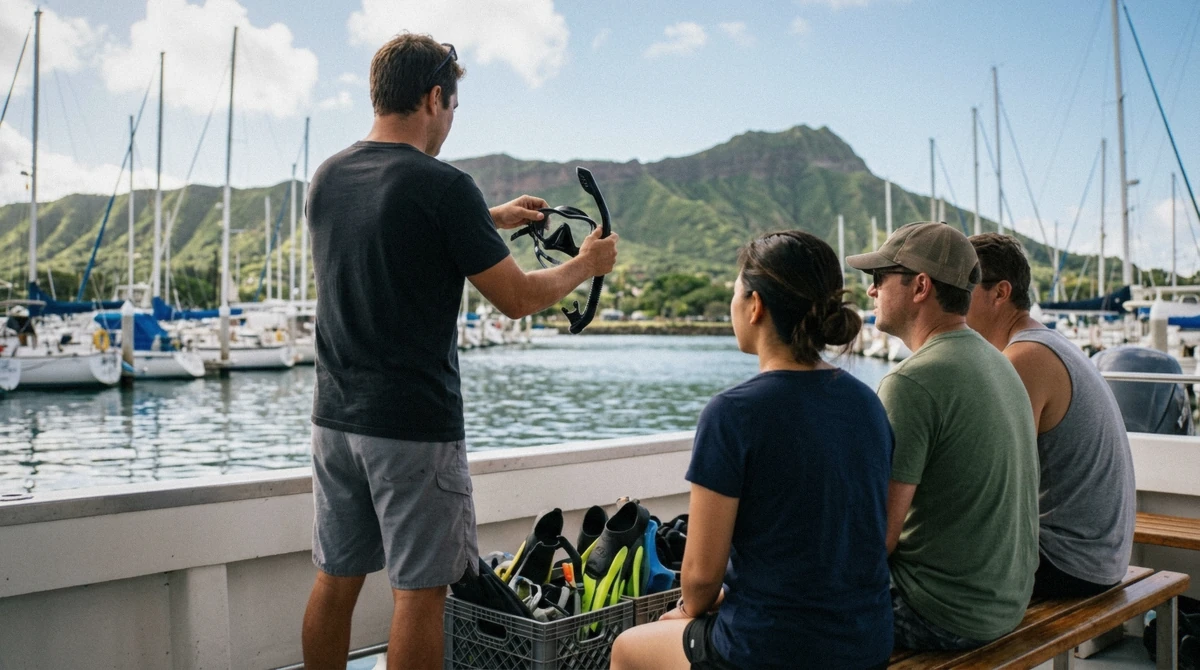
The dock briefing covers the whole craft: slip in quietly, follow the crew's line, exit fast.
Who Can Do It
The swimmer bar
Both dedicated swim tours expect guests to be confident, capable swimmers in open water. Life vests and snorkel gear are provided, but the entries happen from a boat that keeps moving, and a swimmer who cannot keep pace for a stretch will spend most passes catching up rather than watching dolphins. Neither operator publishes a formal swim test, but the honest read of the difficulty notes is that this suits someone who already swims well in a pool or calm ocean water, not a total beginner.
Kids and non-swimmers
Age policies differ by boat. On the catamaran swim, infants stay on a guardian's lap and anyone under 18 needs a guardian-signed waiver, but there is no blanket minimum age stated for the swim itself. For a family with a toddler, or anyone who would rather not swim at all, the honest move is not to force a swim tour but to book a watch-deck trip instead, which covers the same coastline and the same spinner pods without asking anyone to enter the water. Dolphins and You and the Ocean Joy cruise both work this way and still snorkel a reef stop separately from the dolphin portion.
What no sighting is scheduled means
No wild boat, swim or watch, can promise the ocean will cooperate on a fixed timetable. Dolphins move with feeding patterns and weather, not a boarding pass, which is why only one operator in this comparison, Dolphin Excursions, puts a written sighting guarantee behind its trip. Every other listing runs on strong historical odds rather than a contract, and a reader deciding between a swim and a watch tour should weigh that guarantee alongside price and boat type rather than assume every boat carries the same promise.
The Two Swim Boats, Compared Briefly
Dolphin Excursions vs Indigo Ocean
Only two listings in this comparison put swimmers in the water with dolphins at all; everything else is a watch-from-the-deck trip. Here is how the two swim boats actually differ. Last verified: August 2026.
| Dolphin Excursions | Indigo Ocean catamaran | |
|---|---|---|
| Price | $193.88 | $187.43 |
| Boat | 32-foot motorboat, small group | 40-foot catamaran, capped at 25 |
| Sighting guarantee | Yes, in writing | No formal guarantee |
| In-water entries | Included in the swim | Up to four across the trip |
| Lunch | Not included | Kalua pork lunch included |
| Departure | Waianae with Waikiki pickup | Waianae, boat departs 7:30 AM |
If you would rather watch than swim
Both swim boats sit at the higher end of the price range in this comparison because getting in the water costs more to run safely than watching from a rail. If the swim itself is not the draw and seeing dolphins is enough, the Dolphins and You and Ocean Joy trips watch from the deck at a lower per-person price, add a water slide or a buffet respectively, and still meet the same legal distance from any spinner pods they pass. Neither of those two claims an in-water swim, and neither should; the moment a listing promises a swim with a spinner pod specifically, treat that as a red flag rather than a bonus, since it would mean the operator is describing something the 2021 rule does not allow.
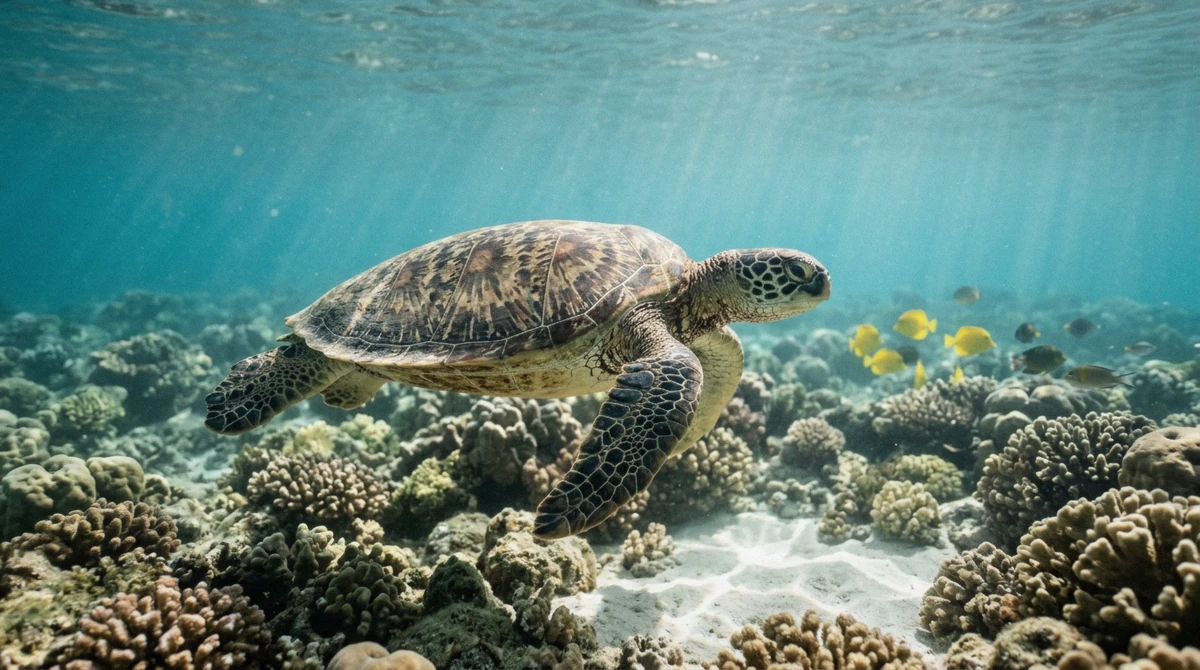
Every swim morning ends the same way: a honu drifting over the Makua-Makaha reef while the adrenaline settles.
Etiquette in the Water
What not to do
The rules that keep a swim legal and the dolphins undisturbed are simple and consistently enforced by crews. No chasing a pod that is moving away. No touching, even if a dolphin swims close enough that it looks invited.
No feeding, ever. No separating a mother and calf pair or swimming directly at an animal head-on. Crews on both swim boats brief this before anyone enters the water, and a guide typically stays in the water alongside guests to reinforce it in real time rather than leaving it to a pre-trip talk alone.
- Never chase a pod moving away from the group
- No touching, even on a close pass
- No feeding under any circumstance
- Never separate a mother and calf
- Approach from the side, not head-on
What it means if a dolphin circles you
A dolphin that circles a swimmer is almost always doing one of two ordinary things: using echolocation to investigate an unfamiliar object in the water, or moving through a resting-pattern circuit it would follow with or without a person nearby. It is curiosity, not communication, and it is not a signal to reach out or try to interact further. The right response is to stay calm, keep your own movement predictable, and let the animal make the next move, which is usually to continue past on its own pace.
Swimming With Dolphins on Oahu: Common Questions
Can you swim with dolphins in Oahu?
Yes, but only with spotted, bottlenose or rough-toothed dolphins from a moving boat off the Waianae coast. Spinner dolphins are watch-only within 50 yards under the 2021 federal rule.
Where can I swim with dolphins on Oahu?
The two dedicated swim tours both depart the west coast near Waianae: Dolphin Excursions and the Indigo Ocean catamaran. Both position swimmers with pods further offshore than the resting spinner pods closer to shore.
Can you still swim with dolphins in Hawaii after the 2021 rule?
Yes, the rule only restricts spinner dolphins. Swims with spotted, bottlenose and rough-toothed dolphins remain legal and are what every Oahu swim tour is actually built around today.
What resort in Hawaii can you swim with dolphins?
Dolphin Quest, a lagoon program at The Kahala Hotel & Resort, offers a captive alternative to a wild boat swim. We compare the two honestly, including cost and ethics, in Dolphin Quest vs a wild boat tour.
What does it mean if a dolphin is circling you?
Usually echolocation curiosity about something new in the water, or part of a resting-pattern circuit. It is not an invitation to touch or chase; staying still and predictable is the right response.
Is swimming with dolphins from the shore legal on Oahu?
No. Swimming out to a spinner pod from the beach falls under the same 50-yard rule as a boat approach and is illegal. Our guide to seeing dolphins free from shore covers what watching from the beach legally looks like instead.
Do I need to be a strong swimmer to do a dolphin swim tour?
Yes, more than a casual snorkel trip. Entries happen from a boat that keeps moving to match the pod, so guests need to swim confidently in open water rather than float in place.